Five Trades, One Ticker, and $350 I Watched Walk Away
IMCC, and the gap between reading the market right and executing on it mechanically
Jump to a section
One ticker, five trades, and a final number that doesn’t come close to describing what actually happened. I was right about IMCC — direction, timing, the setup itself — and still found a way to turn it into a losing day.
The trade ledger
| # | Time In | Time Out | Duration | Shares | Reasoning | Result | Running P&L |
|---|---|---|---|---|---|---|---|
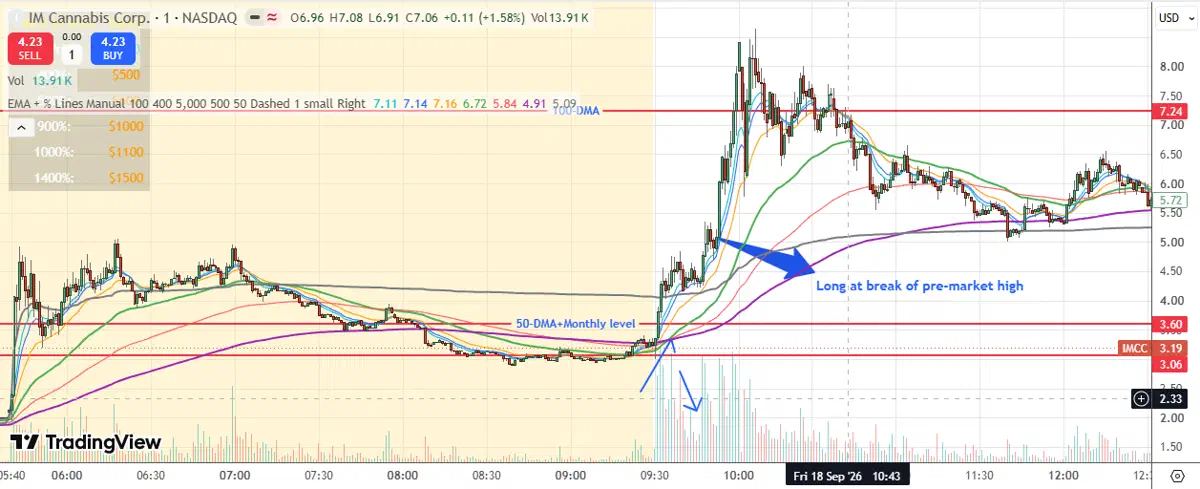
| 1 | 09:53:00 | 09:53:19 | 19 sec | — | Pre-market high break at $5 (psych level, high volume) → retrace to $5 on lower volume → curled back up; 9-EMA (1-min) double tap + VWAP confluence | +$18 | +$18 |
| 2 | 10:06:40 | 10:06:48 | 8 sec | 50 | Entered at the 100-EMA on the daily chart (100 DMA) | -$29 | -$11 |
| 3 | 10:08:xx | ~10:08:+13s | 13 sec | 50 | Engulfing candle on the 1-min chart, right at the 100 DMA, entered $7.52 | +$8 | -$3 |
| 4–5 | — | — | — | — | No clear technical justification — revenge trades | -$7 combined | -$10 |
That table is the entire day. Trade 1 was correct and closed in 19 seconds. Trade 2 gave back the win and then some, in 8 seconds. Trade 3 clawed most of it back. Trades 4 and 5 had no technical reasoning behind them at all — just an attempt to end the day green after a long stretch of not seeing one.
IMCC, in facts
0.09M Float Healthcare · Drug Manufacturers
| Metric | Value |
|---|---|
| Company | IM Cannabis Corp. — medical cannabis import, distribution, and cultivation in Israel and Germany |
| Brands | IMC, BLKMT, LOT420 |
| Headquarters | Toronto, Canada / Tel Aviv, Israel |
| Float | 0.09M shares |
| Why the float is this thin | A 30-for-1 share consolidation, effective late August 2026, reduced total shares outstanding from roughly 18.1M to about 604,000 |
| Catalyst | None identified. Finviz flagged this exact session as a “150% pre-market jump” with no clear catalyst — independently matching what I already suspected before taking the trade |
That last line matters. I didn’t discover after the fact that there was no catalyst — I knew it going in, took the trade anyway on pure technical structure, and still let the absence of a catalyst talk me into cutting the winner short. The setup didn’t need a news story to work. My own conviction needed one, apparently, even when my rules didn’t.
Why Trade 1 was actually a good trade
- Momentum emerging from the 9-EMA on the hourly chart
- Strong green volume on the way up, noticeably lower volume on retracements — the classic signature of a stock building toward a bigger swing, not just spiking randomly
- Price double-tapped the 9-EMA on the 1-minute chart while sitting close to VWAP at the same moment — two confirmations landing together
- Broke the pre-market high around $5 — a major psychological level — on high volume
- Retraced back to $5 on reduced volume, then curled back up — exactly the kind of low-volume pullback that suggests sellers were exhausted, not in control
Every one of those five conditions was real and present before I entered. This wasn’t a lucky guess dressed up afterward as a good read — it was a correctly identified, multi-confirmation setup that I then failed to give room to work.
What happened after I stopped watching
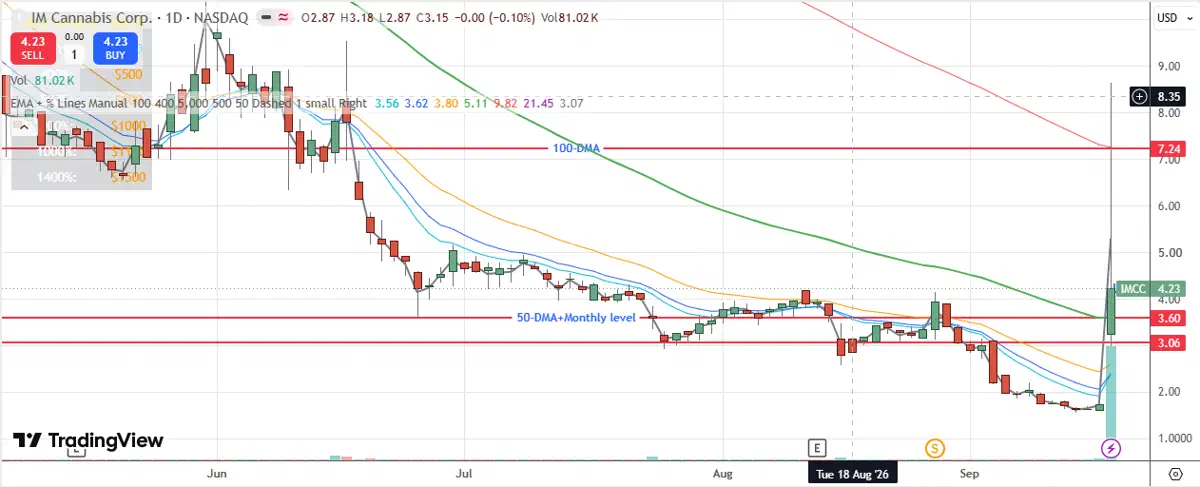
I closed trading for the day at 10:37 AM. Real trading data for the session shows IMCC still active well into the afternoon, up 144.83% and trading at $4.26 as of 3:29 PM — but that’s meaningfully below the $7.52 level my third trade was entered at, which tells its own story: the stock ran further after I stepped away, then gave back a real chunk of the move by afternoon. That’s worth being honest about rather than only citing the number that supports “I should have held longer.” The $350 estimate on Trade 1 assumes an exit somewhere near the late-morning highs, not a hold all the way into the afternoon fade — the lesson isn’t just “let winners run,” it’s “let winners run and still have a plan for where you get out.”
How I actually find these stocks
Worth documenting, since it’s a real, repeatable process rather than a mystery edge:
| Tool | What It’s For | Cost |
|---|---|---|
| TradingView % change gainers list | Finding the day’s biggest movers in real time | Free |
| thestockmarketwatch.com | Pre-market and after-hours percentage gainers | Free |
| TradingView Watchlist / Details / News panel | Quick context on a mover without leaving the chart | Free |
| Scanz | Used previously — dropped once free tools proved sufficient | Paid (no longer used) |
I don’t use social media to find movers at all. Between a gainers list and a free news panel next to the chart, there wasn’t anything a paid scanner was doing that these two sources didn’t already cover.
The two rules I keep re-learning
The harder lesson is the one about switching tickers. I have a real tendency to hop from stock to stock hunting for the next mover, and I’m only recently internalizing that when there are no good trades, there are no good trades — chasing motion for its own sake is exactly how trades 4 and 5 happened. Those two weren’t a read on IMCC. They were an attempt to erase Trade 2’s damage and end the day positive, since it had been a long stretch since the last genuinely green one. That’s revenge trading by definition, and it cost the small edge Trade 3 had already clawed back.
What today actually proves
I don’t have a stock-picking problem. Five trades on one ticker, one of which was built on a real, five-part technical confluence that played out exactly as read — the analysis isn’t the gap. The gap is narrow and specific: mechanical execution once the read is already correct. Trade 1 needed patience it didn’t get. Trades 4 and 5 needed a reason to exist that they never had. Both failures point at the same fix, and it isn’t a new indicator or a better scanner — it’s the discipline to let a correct read run its course without needing the P&L ticker to confirm it every second along the way.
Related reading: The Real Cost of a Mediocre Trade — on risk-budget depletion and the Monday-through-Wednesday pattern · Knowing When to Stop — on protecting a good decision from a tired one · Sixteen Fills, One Regret — the last time overtrading was the actual story.
Nothing in this post is financial advice — see the Disclaimer for the full statement.