VEEA and the Squeeze I Was Too Afraid to Trade
42.21% short interest, a triple-bottom confluence I've been asking for my whole trading life, and the fear that kept my hands off the keyboard
Jump to a section
I placed zero trades today. That sentence alone would usually mean nothing went wrong — no losses, no overtrading, no death-by-a-thousand-cuts session. Today it means something worse: I watched a stock hand me the single best pattern confluence I know how to read, and I didn’t touch it, because a $78 loss from three sessions ago on ELMT is still living in my head.
The setup that walked past me
1.59M Float Technology · IT Services
VEEA is Veea Inc., an edge-computing and cybersecurity infrastructure company built around its VeeaONE platform. The catalyst behind this week’s move is real and specific: Veea signed a term sheet to combine with NovaGen Group B.V., a regenerative-medicine and longevity company, to launch a new entity called NovaGen Health Networks — an edge-AI-powered health platform combining Veea’s infrastructure with NovaGen’s cellular reprogramming science. GeoNova Capital signed a parallel term sheet to invest an initial $10 million as a cornerstone investor, with the combined company valued at roughly $750 million and targeting a Nasdaq listing under the new name. Rollout is planned in two phases starting Q4 2026, beginning with a household health hub and patient-controlled records wallet.
None of that is confirmed, closed, or guaranteed — the release itself is explicit that both the merger and GeoNova’s investment remain subject to definitive agreements and closing conditions. That matters, because a term-sheet-stage catalyst like this one carries real deal risk, not the certainty of a closed transaction. The market tends to react immediately and violently to the possibility of a deal, well before any of the legal machinery that actually closes one has finished turning. A term sheet is a real, meaningful step — more concrete than a rumor — but it’s still a step, not a signature on a definitive agreement. The rollout itself is planned in two phases: an initial household health hub with a patient-controlled records wallet targeted for Q4 2026, followed by a later phase adding clinician-supervised diagnostics and cellular therapy pathways once clinical validation and regulatory authorizations are in place. Phase two, in particular, is a long runway away from where the stock trades today.
The numbers that actually moved the stock
From a base of $1.51, VEEA ran to a high of $4.32 on September 14th — a move of 188.71% — trending for a straight 18.5 hours on volume of 4.13 million shares. Total volume by the end of today stood at a genuinely enormous 202.18 million shares, several multiples of the entire 1.59 million share float.
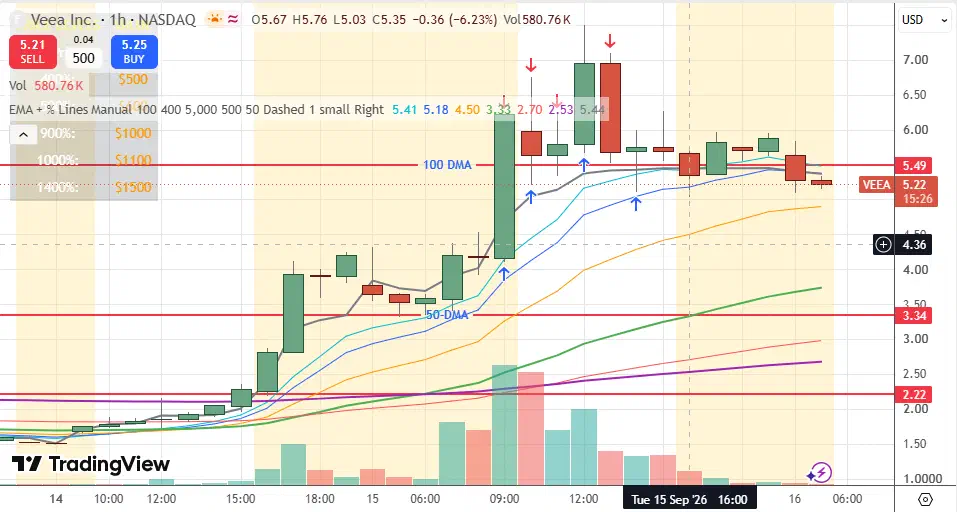
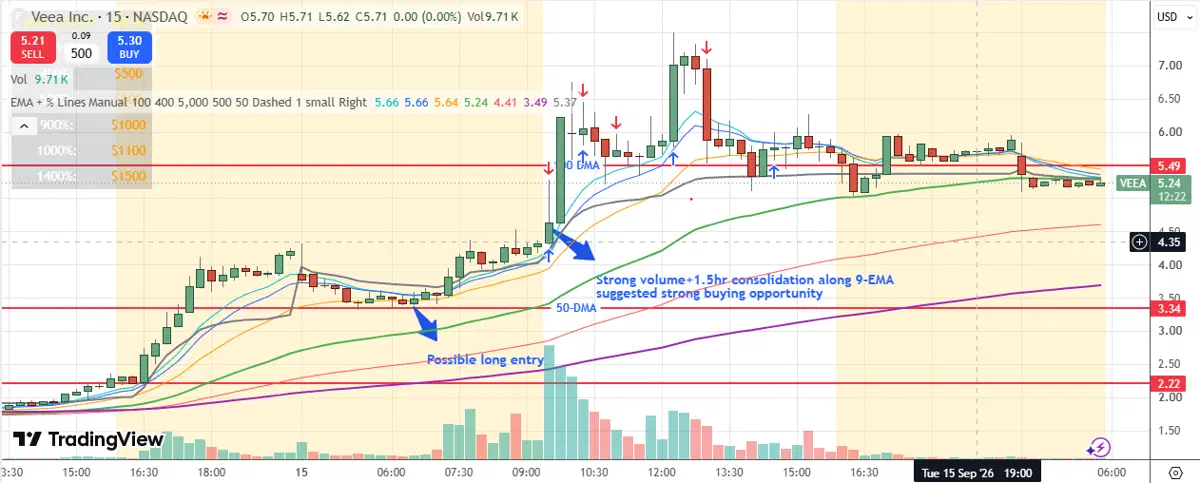
Today’s session opened with a sell-off. The 50-day moving average (50 DMA) sat at $3.34, and price came down to triple-bottom exactly at that level on the 5-minute chart, on volume of 3.9 million shares during the retracement alone. At the same time, on the hourly chart, price found support at the 9-EMA. A triple bottom on a lower timeframe landing precisely on a higher-timeframe moving average, confirmed simultaneously by an hourly EMA hold — that confluence is, in my own words from watching it happen, the single best pattern I could have wished for. I didn’t take it.
The bigger one I missed later the same day
The first missed setup wasn’t even the expensive one. Later in the session, VEEA held the 9-EMA on the 15-minute chart for about 1.5 hours, trading 5.54 million shares inside a very tight consolidation range. A stock holding a higher-timeframe EMA for that long, on that much volume, inside that narrow a range, is about as clean a “the next move will be a strong one” signal as this journal has ever documented.
I didn’t trade this one either, and the reason is worth stating honestly rather than dressing up: I was afraid of chasing a stock with 42.21% short interest. That fear existed despite two pieces of evidence directly contradicting it. First, price had been stable with no jerky, panicky reactions throughout the entire prior day’s surge — nothing about the tape looked like a trap. Second, volume was consistently higher on the up-candles than the down-candles, a real and legitimate tell that buyers were in control on a structural level, not just during brief spikes.
What the real outcome actually was
I’m writing this the same day it happened, and real-time financial reporting on VEEA already shows the stock continuing well past where I stopped watching — multiple sources report shares reaching $6.23 in the same session, a further leg beyond both levels I was tracking. Measured from the 50 DMA triple-bottom at $3.34, that’s an additional 86.5% of upside after the exact confluence setup I identified but didn’t trade. Measured from the second missed setup around $4.28, it’s still roughly 45.6% further upside on top of an already-strong consolidation read.
I want to be precise about what this does and doesn’t prove. It doesn’t prove the trade was guaranteed to work — no setup ever is, and I only know the outcome now because the session is already over. What it does confirm is that my read of the pattern was accurate in real time, before the outcome existed to bias me. The gap here isn’t an analysis problem. It’s an execution problem, and specifically a fear problem.
VEEA’s short interest, in context
That 42.21% figure isn’t a rough estimate — it’s precisely what you get dividing the 671,095 shares FINRA reported short as of the August 31, 2026 settlement date by VEEA’s 1.59 million share float. For context on what that number actually means: general short-interest research consistently treats anything above 20% of float as “heavy” bearish positioning, and above 30% as entering real squeeze-fuel territory. VEEA, at 42.21%, sits meaningfully inside that zone. Days-to-cover of 2.84 adds to the picture — it’s not an extreme outlier on its own (some historically squeeze-prone names have carried double-digit days-to-cover), but combined with a float this thin and volume this explosive, it means short sellers genuinely cannot exit cleanly if the price keeps moving against them.
For scale, the most famous short squeeze in modern market history — GameStop in early 2021 — involved float-adjusted short interest that briefly exceeded 100% of the tradeable float, alongside days-to-cover past five, and took the stock from roughly $20 to $483 in about two weeks. VEEA’s 42.21% is nowhere near that scale, and I’m not suggesting it should be read as “the next GameStop.” The mechanism, though, is the same one at a smaller scale: a crowded bearish position, a real catalyst, and a float too thin to let the exit happen quietly.
The mechanism that can amplify a squeeze further
Short covering isn’t the only mechanical buying pressure that can pile onto a move like this. When a heavily shorted stock has actively traded options, a rising share price forces options market makers who sold call contracts to buy shares to stay delta-hedged — the higher the stock climbs, the more shares they’re mechanically required to buy, independent of anyone’s opinion on the company. This is sometimes called a gamma squeeze, and it can run in parallel with a short squeeze, each amplifying the other. I haven’t pulled VEEA’s options open interest for this specific move, so I can’t say for sure it was in play here — but it’s worth watching for whenever a thin float starts moving this fast, since it’s part of why these moves can extend further and faster than short covering alone explains.
The other side of the story, because it matters
None of this is a reason to treat VEEA as a safe or obvious trade, and it’s worth being just as rigorous about the bear case as the bull case. Independent coverage of the stock has flagged real balance-sheet concerns: a quick ratio near 0.1 and heavy ongoing operating losses, meaning the company doesn’t have a long runway without further capital raises or restructuring. A company in that position issuing new shares to fund operations is a genuine risk to any existing squeeze — dilution from a capital raise can flood exactly the kind of supply a short squeeze depends on being scarce, and can happen with very little warning once a stock has run this far, this fast. High short interest and thin fundamentals aren’t contradictory; they frequently travel together, and both need to be priced into any decision about the stock, not just the one that supports the trade you already want to take.
VEEA’s own recent history of big moves
I almost put a second row in this table — a jump from around $0.10 to above $2 in late August that I’d seen floating around as an “explosive rally.” Looked closer at it and that move lines up almost exactly with a 1-for-20 reverse stock split the company pushed through on August 28th. A 1-for-20 split multiplies the share price by twenty on paper without a single share of real buying behind it — ten cents times twenty is two dollars, full stop, that’s arithmetic, not demand. The stock actually dropped almost 7% in its first session trading post-split, which tells you plenty about how much real conviction was actually behind that “surge.” Not counting a stock split as a trading pattern:
| Date | Catalyst | Base | High (real-time reporting) | Move |
|---|---|---|---|---|
| Sep 14–15, 2026 | Vera-NovaGen merger term sheet + $10M GeoNova investment | $1.51 | $6.23 | ~313% |
One real number beats a fake second data point every time. If VEEA runs again on a genuine catalyst in the coming weeks, that’s the start of an actual pattern worth tracking — not something I’m going to claim off a sample size of one.
Sector context matters too: per my own tracked sample of big movers, Technology is one of the sectors that consistently produces the largest average moves — which is exactly the kind of base rate that should have added conviction here, not just the individual setup.
The actual cost of today
Every post in this journal usually measures the day in dollars lost. Today’s real cost doesn’t show up that way — it shows up as an opportunity that a documented, textbook-quality setup handed me for free, which I let pass because a loss from three trading days ago hadn’t finished processing yet. That’s a harder kind of loss to quantify, and possibly a more important one to fix, because dollar losses come back with better execution. A pattern of freezing at exactly the moment my own system says “go” doesn’t fix itself just by being right more often.
I don’t want to lose sight of the parts of this that are actually working, either. I have not blown up this account in over five months — which, on a percentage basis, is a real achievement given how aggressively some of the setups in this journal could be sized. I am consistently finding the stocks in play, which used to be the hard part and now genuinely isn’t. My read on VEEA today was correct in real time, not in hindsight. The gap remaining isn’t strategic. It’s emotional, and it’s specific: I need to be able to take the trade when my own criteria are met, even — especially — right after a loss has made me want to protect what’s left instead.
What I’m carrying forward
- High short interest needs a catalyst and technical confirmation before it’s tradeable — and today had both. The fear of “chasing a squeeze” shouldn’t apply equally to every heavily shorted name; it should scale down specifically when price action is orderly and volume confirms direction, exactly as VEEA’s was.
- Volume asymmetry between up-candles and down-candles is real, actionable information, not a secondary detail — I read it correctly today and still didn’t act on it, which is the more important failure to fix than not noticing it at all.
- Verify a “prior big move” claim before letting it add conviction to a setup. I almost let a mechanical stock-split artifact masquerade as a second proof point for VEEA’s squeeze potential — a real reminder to check whether a percentage move survived a split, dilution, or other corporate action before treating it as evidence of anything.
- A loss from a prior session has a half-life that outlasts the session it happened in. ELMT cost $78 in real dollars three days ago; today it may have cost considerably more in a trade I was otherwise fully equipped to take.
- Zero trades is not automatically zero risk. The real risk in a session like today isn’t a red number in the account — it’s reinforcing a pattern where fear, not analysis, decides which correctly-identified setups actually get traded.
Related reading: The Real Cost of a Mediocre Trade — the ELMT session still shaping today’s hesitation · Does VWAP Even Work on Low-Float Stocks? — the original case for higher-timeframe confluence on thin floats · Knowing When to Stop — on protecting a good decision from a tired or fearful one.
Nothing in this post is financial advice — see the Disclaimer for the full statement.