The Real Cost of a Mediocre Trade
ELMT, FTFT, and what prospect theory says about turning a winner into a loss
Jump to a section
Some trading days lose you money because you were wrong about the market. Today wasn’t one of those days. I lost $78.20 — enough to take my equity from $1,880.11 down to $1,801.91 — on a stock where my own instincts were telling me, correctly, not to get involved in the first place. That’s a more useful kind of loss to sit with than a genuine bad read, because there’s nothing to fix about my analysis. There’s something to fix about my process.
I only traded one ticker today: ELMT. I watched a second one, FTFT, run from $3 to $9.40 without me. Both halves of that sentence matter equally to this post.
ELMT: a real Pentagon deal, and a stock I shouldn’t have chased
10.26M Float Aerospace & Defense
The Elmet Group is about as legitimate a catalyst stock as this journal has ever covered. The U.S. Department of War announced a $450 million equity investment in Elmet — a near-20% government stake — to rebuild domestic tungsten supply chains and reduce reliance on Chinese sourcing. Tungsten has the highest melting point of any metal on the periodic table, and it’s genuinely irreplaceable in armor-piercing ammunition, missile components, and aerospace propulsion systems. Elmet is the only fully vertically-integrated U.S. tungsten and molybdenum producer, and it supplies programs like the F-35, Patriot, THAAD, and the Virginia- and Columbia-class submarines. Real reporting put the intraday move as high as 55% on the announcement — bigger than anything I was tracking in real time, which is worth sitting with on its own: even a stock I was actively watching moved further than my own read of it captured.
This is not a stock I usually cover here. Most of what fills this journal is sub-2-million-float microcaps where a single news wire can move the price 500%+ on thin volume. ELMT’s 10.26 million float is a different animal entirely — moderate, not razor-thin — and that distinction matters more than I gave it credit for this morning.
A few details from the deal itself are worth knowing, because they explain why the market’s reaction was so immediate rather than a slow grind. The investment is structured as redeemable preferred equity plus warrants covering up to 19.9% of Elmet’s common stock — not a simple cash grant, but a structure that gives the government real upside participation without an outright acquisition. Funding starts with a $200 million drawdown at closing, with additional draws to follow, and Elmet has already earmarked over $165 million for manufacturing expansion across plants in Maine, Michigan, and Ohio, plus roughly $150 million toward restarting a tungsten processing joint venture in Nevada. China currently controls an estimated 85% of the global tungsten market, which is the strategic backdrop that made this specific deal newsworthy well beyond the usual defense-contractor press release — it’s being read as a direct move to break a single-country supply chokehold on a metal the military genuinely cannot substitute.
The setup, and why my gut was already against it
Before I placed a single order, I had a specific, articulable feeling: the stock lacked the momentum to push itself higher because it was already overextended. I ignored that. That single sentence is the actual root cause of everything that happened afterward, and everything below is really just the mechanical unfolding of that first decision.
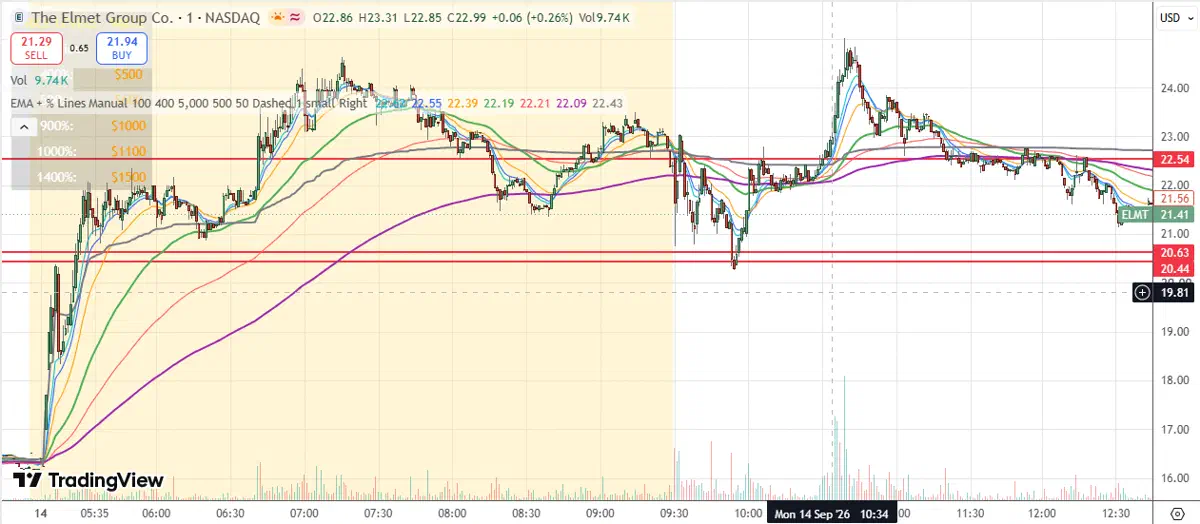
The structure, in numbers: an initial impulse leg of $5.85, measured from a base of $16.25, on volume of 59,000 shares — that’s the leg that took ELMT to its all-time high of $22.54. What followed was a tight consolidation of just $1.09, but on volume of 117,000 shares, nearly double the impulse leg’s volume packed into a much narrower range.
That detail is worth pausing on longer than I did this morning. A tightening range on rising volume is usually read one of two ways: real accumulation (larger buyers absorbing supply quietly before another leg up), or distribution disguised as consolidation (the exact opposite — sellers using the pause to exit into whatever demand shows up). I read it as the former. The rest of the session argued for the latter.
Trade one: paying $20 just to find out I was flat
My first entry was a bounce off the 12-EMA on the 5-minute chart. The position went essentially nowhere — no real gain, no real loss on the move itself — but the bid-ask spread on ELMT was running around 10 cents, and by the time I’d paid that spread on entry and again on exit, I was down $20 without the stock ever actually moving against me in any meaningful sense.
This is worth naming explicitly because it’s a distinct category of loss from everything else in this post: I didn’t lose this money to being wrong. I lost it to trading a name whose transaction costs didn’t fit the size and timeframe I was trying to scalp. A 10-cent spread is a real, fixed tax on every round trip, and on a fast 5-minute scalp, that tax can eat the entire edge before the trade idea even gets a chance to be right or wrong.
Trade two: from +$20 to -$58, and what actually happened in my head
The second entry was better-reasoned on paper. ELMT had broken below VWAP, touched its all-time high of $22.54, and bounced. I entered at $22.90 on that bounce. The trade worked immediately — I was sitting on roughly $20 of unrealized profit.
Here’s where it went wrong, and it’s worth being precise about the mechanism rather than just saying “I got greedy.” I was expecting the stock to push into new highs, so I let the position run past my actual thesis, planning to exit only once price came back down through the all-time-high level and broke back below VWAP. That’s not a bad exit plan in the abstract — it’s a real, definable invalidation level. The problem is I only decided on it after I was already up $20, not before I entered. When price actually did reverse, touched the all-time high, and broke back below VWAP exactly as I’d said it would, I still didn’t exit. I let it keep going. The $20 winner became a $58 loss.
There’s a well-documented behavioral pattern underneath this exact sequence, and it has a name: the disposition effect, rooted in Daniel Kahneman and Amos Tversky’s Prospect Theory. Their research found that people feel the pain of a loss roughly 2.5 to 3 times more intensely than the pleasure of an equivalent gain. In practice, this produces a very specific, very common failure mode: traders cut winners short out of fear the gain will evaporate, and simultaneously let losers run long out of hope they’ll recover — the two errors compounding each other rather than offsetting. My trade managed to do a version of both in sequence: I didn’t take the $20 when it was there because I wanted more, and then once the position flipped negative, the same loss-aversion wiring that should have triggered an immediate exit instead produced hesitation, because closing it meant realizing the loss instead of just watching an unrealized number.
::: {.callout-important} The tape was already warning me. The time and sales window showed a 1,000-share sell execution land while every average execution size up to that point had been running well below 1,000 shares. A single print that much larger than the prevailing size is one of the more reliable tells in tape reading — it usually means a larger participant is done waiting and is taking liquidity now rather than working an order patiently. I saw it. I didn’t act on it. The reversal that followed wasn’t a surprise the tape hadn’t already told me about. :::
The two trades I should have taken instead
The frustrating part of today isn’t just that I lost money — it’s that the chart handed me at least two cleaner setups than the ones I actually traded.
That second one connects directly to a rule this journal has now independently rediscovered across several completely different tickers: a 9-EMA read on a higher timeframe — hourly, or even 30-minute — tends to outperform the same read on a 3-to-5-minute chart, because it filters out exactly the kind of noise that chopped up my actual entries today. The 12-EMA 5-minute bounce that cost me the spread, and the VWAP scalp that turned into a $58 loss, were both lower-timeframe reads on a stock that was actually telling a cleaner story one level up.
FTFT: the trade I watched happen and didn’t take
5.38M Float Software & Application
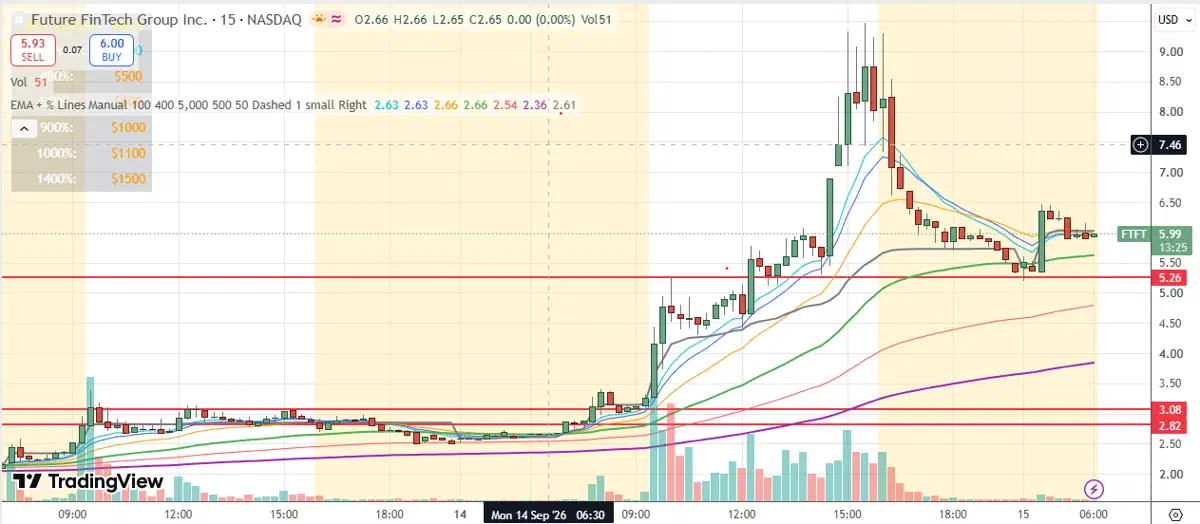
I noticed FTFT at 9:55 AM, right after it broke above a 3-day consolidation pattern, bouncing off the 9-EMA on the 2-hour chart — about as high-conviction a timeframe confluence as a momentum setup can offer. This wasn’t a stock coming out of nowhere, either. Future FinTech Group had already been in a multi-week momentum run heading into today, climbing from under a dollar into the $2-3 range over the prior two weeks on a combination of a recent 1-for-4 reverse split and pure speculative volume — the kind of setup multiple independent trading-news sources were already describing as “classic low-float momentum action” before today’s session even started.
From that 3-day consolidation break, FTFT went on to bounce off the 9-EMA on the 15-minute chart four separate times before finally making its real move — an approximate $4 run beginning at 14:30 and climaxing at 15:45. Zoomed out to the full session, the stock ran from a base of $3 all the way to $9.40 — a move of roughly 213% — before finally selling off.
I didn’t take any of it.
Why I didn’t trade the best setup of the day
The honest answer isn’t technical. By the time FTFT was setting up, I’d already given back over 4% of my account equity on ELMT, and what I actually felt wasn’t indifference — it was fear. Having just been burned by a stock I’d knowingly chased against my own instincts, I didn’t have the appetite left to size into a new position, even a genuinely high-quality one.
This is the part of today that actually costs more than the $78.20 shows on paper, and it deserves to be named precisely: a mediocre trade doesn’t just cost you its own dollar loss. It spends down the risk budget — and the psychological capital — you needed for the good trade that shows up later in the same session. ELMT wasn’t just a $78 loss. It was the reason FTFT, which I correctly identified in real time as a strong setup, never got sized into at all.
The two moves, side by side
ELMT’s impulse leg from its $16.25 base to the $22.54 all-time high works out to roughly a 36% move — a real, tradeable catalyst reaction by any normal standard. It’s just dwarfed by what FTFT did the same morning, on a smaller float, off a cleaner higher-timeframe setup, while I sat on my hands.
What I’m actually taking from today
I want to resist the temptation to turn this into a vague “be more disciplined” conclusion, because the specific, checkable rules sitting inside today’s session are more useful than that:
- Write the entry and exit plan before the trade, not during it. Today’s $58 loss happened specifically because my exit criteria were only decided after I was already in profit — which meant they were competing against loss aversion in real time instead of being a fixed, pre-committed rule.
- When intuition says a stock is overextended, that’s data, not noise. I had the correct read on ELMT before I ever placed an order. Overriding a trained instinct because a catalyst looks exciting is a specific, nameable mistake, not bad luck.
- Weight 9-EMA setups on higher timeframes above the same setup on a lower one. This is now the second or third time this journal has independently found the same result across completely different tickers: the hourly or 2-hour version of a 9-EMA read consistently outperforms the 3-to-5-minute version of the same idea.
- Watch time and sales for execution sizes that break the pattern. A single 1,000-share print against a backdrop of sub-1,000-share executions was a real, actionable warning today. It’s worth building a habit around, not just noticing in hindsight.
- Protect the risk budget for the best setup of the day, not just the first one. My own tracked data shows the first three trading days of the week tend to produce the biggest movers — which means Monday-through-Wednesday is exactly the wrong stretch to burn capital and courage on a mediocre, instinct-overriding trade before the real setup of the week even shows up.
FTFT was, by my own read at 9:55 AM, the trade to take today. I didn’t take it — not because I missed it, but because I’d already spent the capital and the composure it required on a stock I never should have chased in the first place. That’s a more precise, more fixable failure than “I had a losing day,” and it’s the one I actually want to carry into tomorrow’s session.
Questions I keep getting asked about days like this
Why did my winning trade turn into a loss even though my original thesis was right? This is almost always an exit-planning problem, not an analysis problem. If your invalidation level is only decided after you’re already in profit, it has to compete against loss aversion in real time — the exact bias that makes people hold losers too long and cut winners too short. A pre-committed exit, written down before entry, removes that decision from the moment it’s hardest to make correctly.
What does it mean when a stock breaks below VWAP and then reclaims it? A break-and-reclaim of VWAP is generally read as a sign that the initial selling pressure has been absorbed and buyers have reasserted control at a level the market was actively testing. It’s a stronger signal than a simple bounce off VWAP without the prior break, because it shows the level was genuinely challenged and held rather than just approached.
Why do higher-timeframe 9-EMA setups tend to work better than the same setup on a 1-to-5-minute chart? Lower timeframes carry proportionally more noise relative to signal — a huge share of the price action on a 1-minute chart is just short-term order flow and market-maker activity rather than a real shift in supply and demand. A 9-EMA tap on an hourly or 2-hour chart has to survive far more trading activity to even form, which filters out a large share of the false signals a 3-minute version of the same pattern would generate.
How do you read an unusually large print in time and sales? Compare the size of the print against the average execution size you’ve been seeing on that name in that session. A single execution meaningfully larger than the prevailing pattern — in today’s case, 1,000 shares against a backdrop of sub-1,000-share prints — often indicates a larger participant is taking liquidity rather than working an order patiently, which can precede a shift in short-term direction.
Have you ever walked away from a great setup because a smaller, earlier loss had already spent your nerve for the day?
Related reading: The Fourth VWAP Tap That Actually Worked — the first time this journal identified the spaced-taps-versus-tight-taps distinction · Knowing When to Stop — on protecting a good decision from a tired one · Does VWAP Even Work on Low-Float Stocks? — the original case for favoring higher timeframes on thin, illiquid names.
Nothing in this post is financial advice — see the Disclaimer for the full statement.