Knowing When to Stop
22 fills, a green day, and the one trade I was proud not to take
Jump to a section
Twenty-two fills across two stocks in under three hours, and I still ended the day green. I want to sit with that contradiction for a second before explaining it away, because the honest version of today isn’t “I traded well.” It’s “I traded badly enough to embarrass myself, and the market happened to be generous about it.” The more interesting story — and the one I actually want to remember — is what happened at 11:02, when I looked at a third setup, recognized I was done, and didn’t touch it.
The session, at a glance
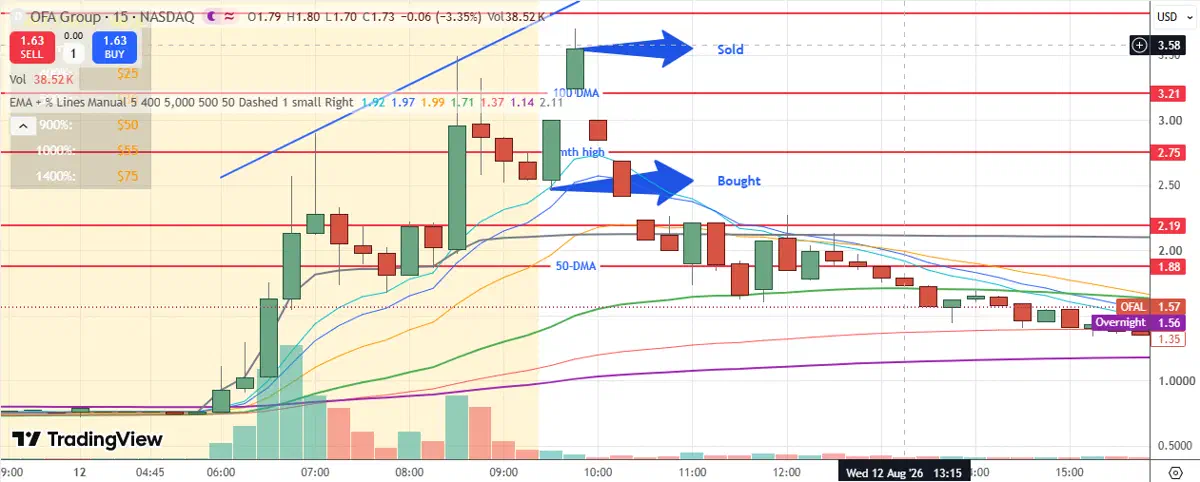
OFAL: a reverse split, a distracted miss, and a trade that actually paid the day’s bills
1.57M Float Engineering & Construction
OFA Group is an architecture, engineering, and AI-driven Building Information Modeling company that had just completed a 1-for-10 reverse split on July 31st to cure a Nasdaq bid-price deficiency — the exact mechanical setup for the kind of low-float momentum move that followed. Financial press covering the session called it plainly: a low-float momentum move rather than a fresh fundamental catalyst, the classic signature of a post-split float squeeze.
The move itself: a 289% initial impulse, a $2.17 dollar move off a $0.75 base, then a 42.47% retracement off that impulse high, a double tap of the 9-EMA on the 15-minute chart, and a fresh surge toward $3.50.
Where the morning actually went wrong
OFAL 15-min chart
BIVI: real Parkinson’s data, a broken rule, and a fast, correct bailout
7.49M Float Biotech
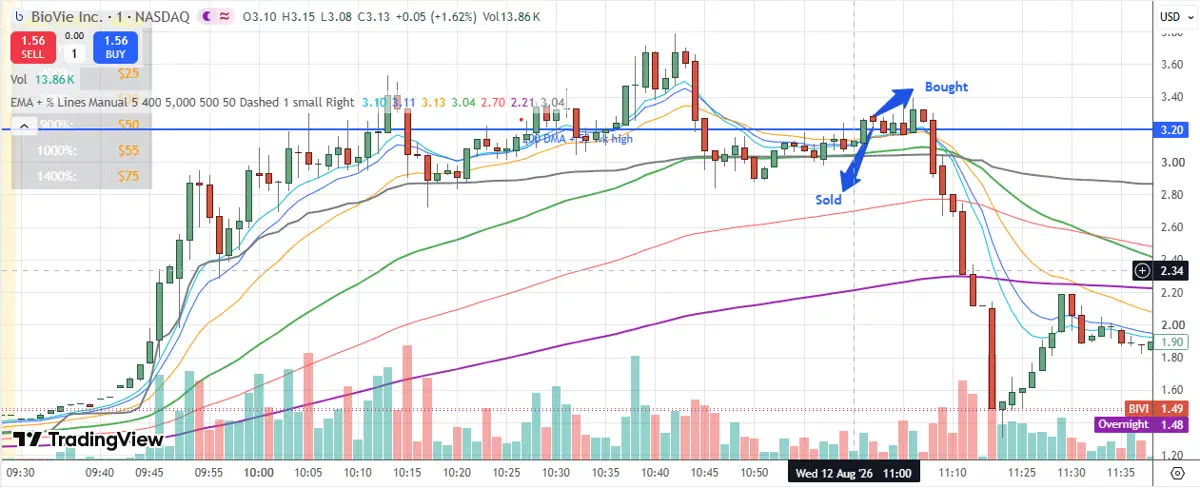
I didn’t check the float before taking this trade. That’s worth stating plainly rather than softening — FOMO took over, plain and simple. BioVie Inc. is a clinical-stage biopharmaceutical company, and the real catalyst behind today’s move was concrete: its Phase 2 SUNRISE-PD trial for Parkinson’s disease met its primary endpoint, improving blood-based biomarkers and reducing associated neuroinflammation. Shares reached a fresh 52-week high near $3.79, up over 22% on the day, according to real-time financial coverage.
The real opportunity was the double tap of VWAP at $2.90, which led to a move up to $3.80 — clearing the confluence of the 200-day moving average and the 52-week high at $3.20. I didn’t take it.
At 11:02 AM, I took a second BIVI trade — 100 shares, right after a strong VWAP sell-off and reclaim, hoping for a surge. I was ready to bail at the first sign of trouble, and I did: price dipped just 8 cents, from $3.29 to $3.21, and I was out.
BIVI 1-min Chart
The moves, side by side
BIVI’s headline number understates my own missed leg — the $2.90-to-$3.80 move I skipped was closer to 31% on its own — but the day’s full reported move is the fairer comparison point across all three names.
BOXL: the one I let go, on purpose
I already had the 100-day moving average marked at $6.85 as a possible entry level. Price consolidated in a tight $6.17–$6.70 range on the 5-minute chart directly beneath it, and then the candle that finally broke that range came in on a disproportionately large volume of roughly 60.21K — by any definition I use, a textbook buy signal. From a psychological $5 level, BOXL went on to run 97.79%, topping out near $9.90 before selling off.
What I didn’t know at the time, and only found out afterward: Boxlight — an education-technology company behind interactive classroom displays — had two real catalysts landing the same day. It returned to profitability in its Q2 2026 earnings, beating EPS estimates, and separately closed the initial tranche of a $5.5 million private placement alongside a new $15 million equity line of credit, both aimed at working capital and debt reduction. The stock had genuinely violent premarket action too — real reporting shows it spiking from roughly $4.35 to above $6.60 within about an hour before settling into the range I was watching. The chart wasn’t lying. There was real fuel behind it.
Full execution log
Download today’s execution log (.xlsx)
What today actually proves
Twenty-two fills is overtrading by any definition, and it’s a habit that’s clearly getting worse, not better — I’m not going to dress that up. But the session also contained the two things that actually matter more than fill count: a mechanical, unemotional exit on BIVI over eight cents, and the self-awareness to recognize fatigue before it turned into a real mistake on BOXL. Spotting the big movers has never been my problem. Today’s real lesson is that stopping — cleanly, before the tank hits empty — is its own skill, separate from entries and exits, and it’s the one I finally practiced correctly.
Have you ever walked away from an obviously good setup because you knew you weren’t sharp enough to trade it well? Tell me about it in the comments — I’d like to know if this gets easier with reps or if it’s always this uncomfortable.
Related reading: Sixteen Fills, One Regret — the last time overtrading was the real story · The Fourth VWAP Tap That Actually Worked — yesterday’s confluence read, one session before this one.
Nothing in this post is financial advice — see the Disclaimer for the full statement.