Does VWAP Even Work on Low-Float Stocks?
What my first pre-market session, DKI, and JWEL taught me the hard way
Jump to a section
$2,195.57 was the number I started today with. $54.70 is what I ended it down. Small in isolation — a little over 2.5% of the account — but the story underneath that number is the one worth writing down, because today wasn’t a normal session. It was the first time I traded the pre-market on purpose, using TradingView’s extended-hours data, on two thin, low-float names out of Hong Kong and China.
I’d discovered that TradingView provides extended-hours data, and it genuinely opened my eyes to how much was happening before the bell that I’d simply never been watching. That realization was correct. What I did with it — jumping straight into trading that session with normal size, on day one, with no track record in it yet — is the part worth examining honestly.
Where the damage actually came from
DKI’s exact figure wasn’t something I logged separately today — I only tracked the day’s total loss and JWEL’s $7 individually — so the $47.70 above is simple subtraction, not a pulled number. It accounts for roughly 87% of the day’s damage on its own.
DKI: a Hong Kong mobile-gaming name and a VWAP level that was already tired
DKI · Hong Kong 0.373M Float
DKI is Darkiris Inc., a Hong Kong-based mobile game developer trading on Nasdaq under the Electronic Gaming & Multimedia industry, Communication Services sector. It’s a genuinely thin name — a 0.373 million share float — and one that’s leaned into an AI narrative recently, including the commercial launch of a generative AI video platform alongside its core mobile gaming business. That AI angle is part of what fueled the retail momentum behind today’s move.
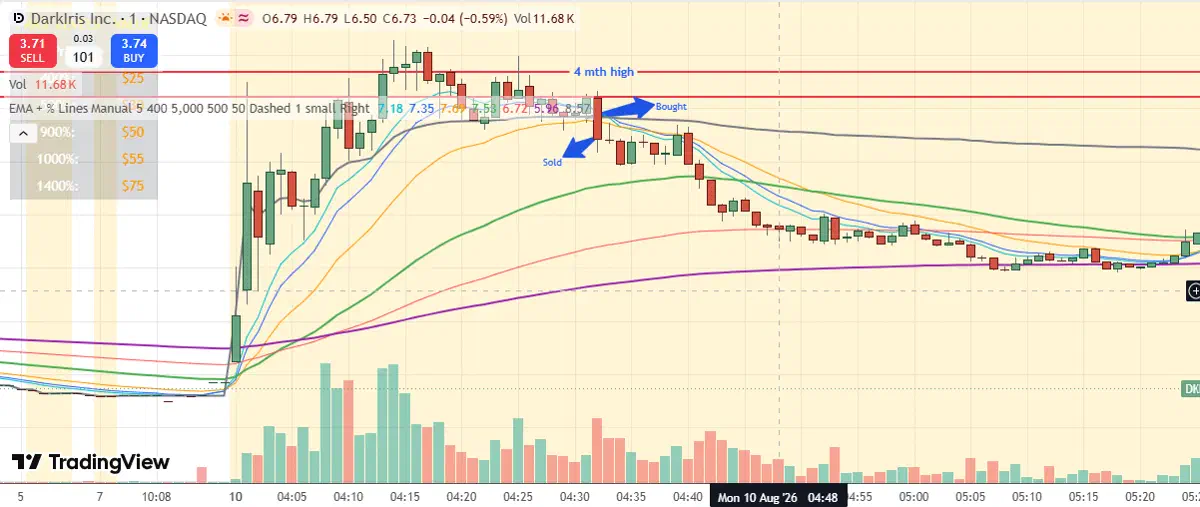
My first trade went in while price was sitting just below a 4-month high. The reasoning, laid out honestly:
Macro: an extremely low float, a Hong Kong listing — a geography that, in my own tracked sample of big movers, has produced the highest average return percentage of anywhere I follow — and a catalyst combining retail momentum with an AI narrative.
Technical: price sitting below a multi-month high, a large initial impulse leg of roughly $6.58, and — this is the detail that matters most in hindsight — a fourth tap of VWAP.
I want to give credit where it’s due: once I was in a losing position, I executed the exit well. Reading Level 2 and honoring my mental stop instead of hoping is a real skill, and I don’t think today’s DKI trade reflects badly on that part of my process. What I do dislike is separate from the read itself — I entered and exited the same name three separate times, six fills total, on a stock that had already told me once that the setup wasn’t there. The first exit should have ended my interest in DKI for the morning. It didn’t.
DKI 1-min chart
JWEL: a panic trade taken at the wrong altitude
JWEL · China 2.03M Float
JWEL is Jowell Global Ltd., a Shanghai-based e-commerce company selling cosmetics, health and nutritional supplements, and household products through its own platform and roughly 26,000 Love Home retail stores across China. It’s a stock with real scar tissue — it IPO’d at $139.36 back in 2021 and has since fallen over 98% — and one that Nasdaq has flagged for minimum bid price compliance before, leading to a prior 1-for-16 share consolidation. Today’s move had no clean company-specific catalyst behind it; this is squarely what one financial write-up called, almost describing this exact stock, a move “more consistent with the dynamics of a thinly traded micro-cap than a clearly identifiable change in fundamentals.”
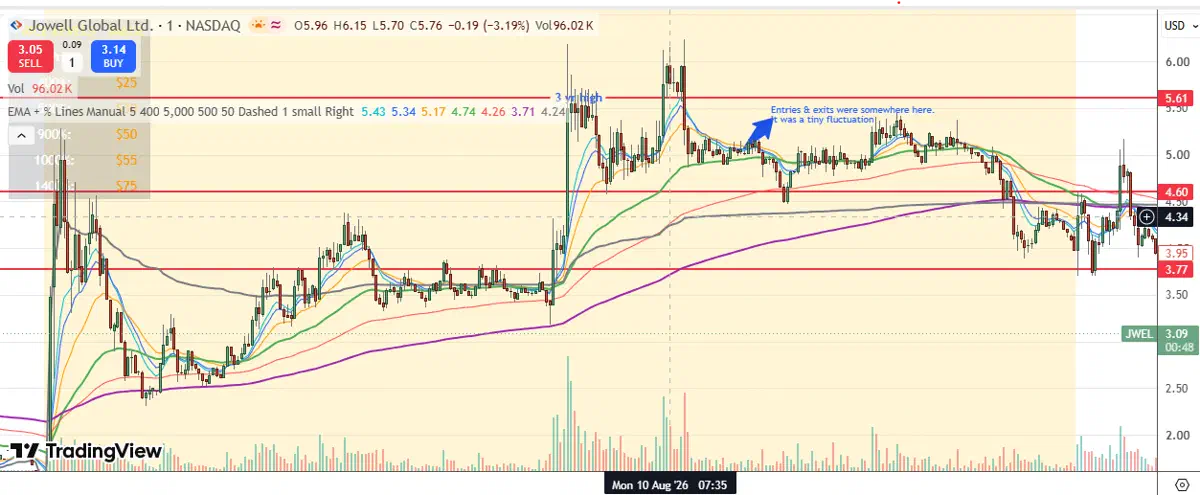
I took this trade because price had tapped the 9-EMA on the hourly chart twice and bounced strongly both times — a real, legitimate signal on its own. Where it went wrong was the entry I actually took versus the one that was available:
Buying directly into a rejection at a three-year high isn’t the same trade as buying a confirmed 3-minute EMA support level, even though both setups involve the same stock and the same larger pattern. The $7 this cost me is almost beside the point — the real lesson is that I shouldn’t have taken a position at all until price actually emerged above that 3-year high following a genuine panic candle.
JWEL 1-min Chart
The actual lesson isn’t about either ticker
Both of today’s losses trace back to the same root cause, and it isn’t “wrong stock” or “wrong setup.” It’s that I opened a brand-new session — one I’d never traded before this morning — and immediately applied full size and full conviction to it, instead of treating it the way I’d treat any other unproven edge: small, deliberate, and closely tracked before scaling up. The rules I broke today (respecting VWAP tap counts, waiting for confirmation instead of chasing a rejection) are rules I already follow reasonably well during regular hours. They just hadn’t been stress-tested in the pre-market yet, and this morning was that test.
Extended-hours data was a genuinely good discovery. The mistake wasn’t opening that door — it was walking through it at full speed on day one.
How I track setups like these
Everything above comes from a dashboard I built myself to track big movers across sessions — you can see it here: highbreakers-wldeu97.public.builtwithrocket.new
If you find something useful in it and want a version built for your own tracking, reach out — ganon298@gmail.com. I’m happy to walk through how it works or adapt it to what you’re trying to track.
Nothing in this post is financial advice — see the Disclaimer for the full statement.